MLC Dharmendra Bhardwaj Launches Meerut Heritage Mission on World Tourism Day
Just another WordPress site
Press Release Disclaimer: This is a press release distributed through the XPR Media network. It has not been independently verified by our newsroom.
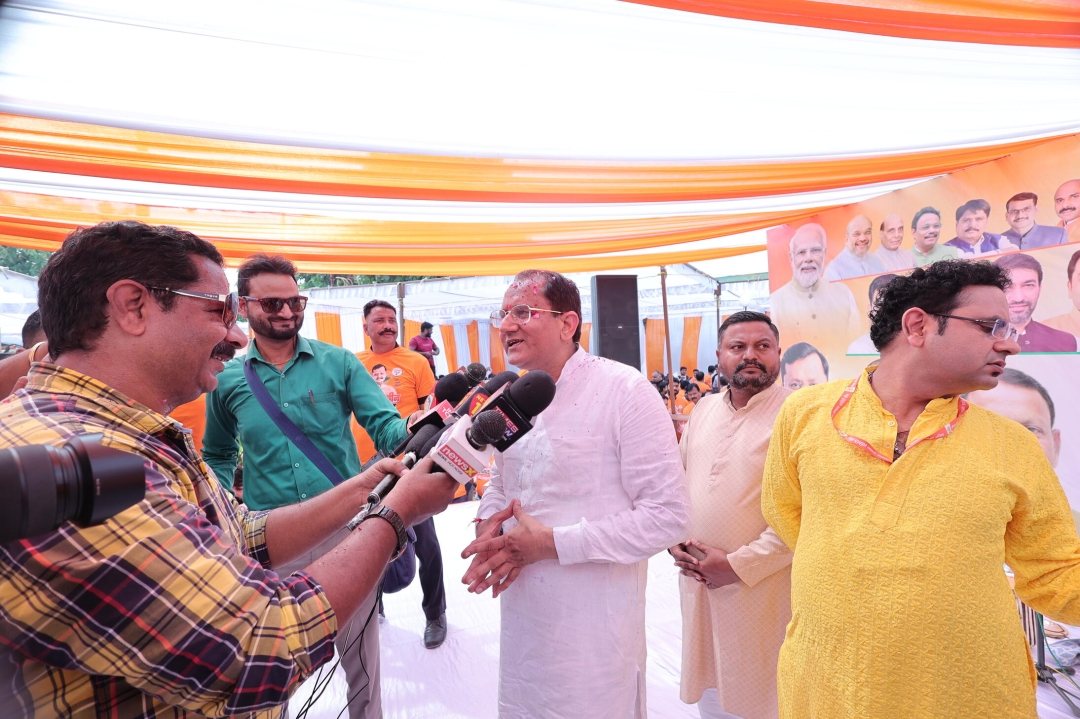

MEERUT, UTTAR PRADESH — Sunday, 27 September 2026 — World Tourism Day — On the day the world marks tourism’s power to build understanding, MLC Dharmendra Kumar Bhardwaj, Member of the Uttar Pradesh Legislative Council from the Meerut-Ghaziabad Local Authorities constituency, today formally announced “Viksit Pauranic Meerut” — a Heritage Internationalisation Mission to place Meerut’s centuries-deep civic inheritance on the national and international heritage-tourism map. The Mission is aligned with UN Tourism’s World Tourism Day 2026 theme of “Digital Agenda and Artificial Intelligence to Redesign Tourism” — a frame the proposals embrace directly, through a permanent digital interpretation centre, artificial-intelligence-assisted multilingual audio guides and QR-coded heritage trails across the city’s flagship sites.
The Mission positions Meerut’s layered heritage — the 1857 freedom struggle, a composite sacred geography, classical music and craft — as one inclusive tourism proposition, with three flagship anchors: the Nauchandi Mela, the Augharnath (Kali Paltan) 1857 freedom-struggle memorial, and the five-site Surajkund interfaith cluster, joined by a proposed heritage corridor to Hastinapur.
“Meerut’s soil carries both India’s freedom and India’s civilisation,” said MLC Dharmendra Kumar Bhardwaj. “Nauchandi Mela, the Augharnath temple, the dargah of Bale Miyan and the five-site Surajkund cluster exist together; without each other they are incomplete. Sabka Saath, Sabka Vikas — this is the operational vocabulary of the Viksit Pauranic Meerut Mission.”
Why this day, and why Meerut. World Tourism Day has been observed on 27 September every year since 1980. UN Tourism — the United Nations agency for responsible and accessible tourism, rebranded from the World Tourism Organization in 2024 — has set the 2026 theme as “Digital Agenda and Artificial Intelligence to Redesign Tourism,” recognising technology’s reach in opening destinations to every visitor. Meerut answers that theme with an endowment few cities can match: within a two-kilometre radius of the Surajkund belt sit five living heritage sites spanning roughly eight centuries and four faiths — a geographic concentration of sacred architecture unmatched in North India outside the capital. The Mission launches on this frame deliberately: its visitor-experience proposals are digital-first, so that a first-time tourist arriving in Meerut encounters the same technology-led interpretation the 2026 theme celebrates.
The Mission’s asks are structured in three layers. Recognition: formal national and international listings — the State Heritage Fair request for the Nauchandi Mela, the freedom-struggle pilgrimage designation for Augharnath, and international tourism-bureau presence for the district’s calendar. Conservation: coordinated, funded stewardship of the Surajkund cluster and the 1857 circuit with the Archaeological Survey of India and the State departments, so that the sites are protected rather than merely promoted. Access: a digital layer — interpretation centres, guided trails, multilingual audio — that turns a set of individually significant monuments into one legible, bookable, visitor-ready destination. Each layer feeds the next; recognition without conservation is a poster, and conservation without access is a locked door.
A living fair, not a monument. What distinguishes the Nauchandi Mela from a heritage site is that it is still alive. The fair is a working economy of crafts, trade and performance — folk theatre and classical and popular music on its stages, artisan stalls alongside the agricultural trading that began the tradition — and it draws its crowds from the villages and towns of western Uttar Pradesh as much as from the city. The Mission’s interpretive-centre proposal is designed around that living character: the centre would document the fair’s oral histories, its craft traditions and its composite origins, so that the story the tourists are told is the story the fair itself tells about its own 350-year run.
The Nauchandi Mela — Meerut’s interfaith signature. The Nauchandi Mela is among the oldest continuously observed fairs in the country. Local tradition holds that in 1034 CE crowds gathered at the spot where the Sufi saint Hazrat Bale Miyan died; the recorded fair began in 1672 as a cattle-trading fair established by local traders, and has run for more than 350 years as a shared Hindu-Sufi event — the Chandi Devi Temple festival and the annual Urs of Bale Miyan observed side by side at the same complex, each community attending the other’s observance. Heritage accounts record a single interruption across that run — 1858, the year after the 1857 uprising. During its month-long run the fair draws heavy crowds: contemporary programme estimates put daily attendance above 80,000 visitors, running to several lakh across the season, with the Indian Railways’ Nauchandi Express train named for the fair. The Mission proposes five measures for the Mela: formal international tourism-bureau listing; a permanent interpretation centre at the Mela grounds; cultural-exchange programmes with comparable composite-fair traditions across South Asia; a sustainable visitor-management plan prepared with the Meerut Municipal Corporation and the Meerut Development Authority; and a formal request to the Chief Minister’s office to declare the Nauchandi Mela a State Heritage Fair.
Augharnath — the 1857 freedom-struggle memorial. The Augharnath temple — the Kali Paltan Mandir in Meerut Cantonment — is a Shiva temple housing a svayambhu Shivalinga, and the site associated with the planning meetings of the native soldiers who carried out the 10 May 1857 outbreak — the first armed rising of the Indian Rebellion of 1857. The historical record is precise. Eighty-five troopers of the 3rd Bengal Light Cavalry refused cartridges rumoured greased with cow and pig fat for the Enfield rifle; they were court-martialled on 9 May 1857; the garrison rose in revolt the next day; and Colonel John Finnis of the 11th Bengal Native Infantry — the first British officer killed in the uprising — fell on the parade ground. The revolt then marched to Delhi and set the end of East India Company rule in motion. The Mission proposes four measures here: development of Augharnath as a national freedom-struggle pilgrimage site on the Ministry of Culture’s heritage circuit; a permanent 1857 interpretive gallery; coordination of the British-era St. John’s Church and the Cantonment Cemetery — where Colonel Finnis lies buried — into a single 1857-memory circuit; and an annual 10 May commemorative academic symposium organised with Chaudhary Charan Singh University, Meerut (NAAC A++, established 1965), beginning with the 170th anniversary in 2027.
The Surajkund cluster — a composite sacred precinct. The Mission’s centrepiece is the Surajkund cluster — five living heritage sites within walking distance of one another. The Chandi Devi Temple anchors the Nauchandi Mela’s Hindu observance. The Surajkund temple and park give the precinct its name. The dargah of Hazrat Bale Miyan was built in 1194 CE by Qutub-ud-din Aibak, the first ruler of the Delhi Sultanate — making the shared pilgrimage tradition at the site roughly 830 years old, with the Urs observed alongside the Nauchandi Mela and both communities participating. The dargah of Shahpir was built in 1620 by Empress Noor Jahan in memory of Hazrat Shahpeer, an advisor and physician at the court of Emperor Jahangir; local legend holds it was completed within twenty-four hours, and the monument carries Archaeological Survey of India recognition, with its annual Ramzan fair drawing pilgrims from across North India. The 1857 Mutineers’ Mosque stands at one of the execution sites of the revolt’s aftermath. The Mission proposes the cluster be developed as a single integrated heritage-precinct conservation project with the Archaeological Survey of India, the Uttar Pradesh State Archaeology Department and the Meerut Development Authority, modelled on the central government’s HRIDAY heritage-city framework. The cluster’s singular value is its composite character — it cannot be told as a single-faith story. Sabka Saath, Sabka Vikas, Sabka Vishwas, Sabka Prayas is not a slogan here; it is the precinct’s 830-year operating reality. The walking scale is the practical asset: a visitor can stand at the Chandi Devi temple, the Surajkund park, the dargahs and the Mutineers’ Mosque in a single morning — a density of interfaith heritage that itinerary designers elsewhere must stretch across an entire district, delivered here in one neighbourhood.
Hastinapur — the classical link. Forty kilometres from Meerut lies Hastinapur — the capital of the Kuru kingdom in the Mahabharata and one of the holiest Jain pilgrimage centres, revered as the birthplace of three Tirthankaras: Shantinath, Kunthunath and Aranath. The Mission proposes a Meerut-Hastinapur heritage corridor, linking Surajkund’s composite sacred geography, Augharnath’s freedom-struggle memory and Hastinapur’s classical-civilisational depth into a multi-day visitor itinerary. Within Meerut city, the Gandhi Bagh gardens and the historic Shahi Eidgah round out the circuit.
Tourism and trade — the sports-industry synergy. The Mission’s tourism pitch is cross-leveraged with the Western UP Sports Industry Council, which Dharmendra Bhardwaj MLC convened on 27 August 2026. Meerut produces 40–45 per cent of India’s sports-goods exports through a cluster of 9,878 registered units employing 3.15 lakh workers, with an annual turnover of ₹1,500–1,750 crore and shipments to more than 100 countries. The Sports Goods Export Promotion Council’s chairperson Sumnesh Agarwal — a Meerut-based exporter whose Premier Legguard Works stands at the A-6 Sports Complex on Delhi Road — anchors the Council’s buyer-delegation programme — covering markets including the United States, the United Kingdom, Australia, Germany, France, South Africa and New Zealand — which will run parallel to the Heritage Mission’s cultural-exchange calendar: every international visitor drawn to Surajkund is introduced to the Partapur sports cluster, and every foreign buyer arriving for the export houses is introduced to Meerut’s composite heritage. Tourism and trade become one inbound proposition, and the heritage circuit gains a built-in stream of international visitors through the year, not only in fair season.
Sabka Saath as the operational vocabulary. The Mission’s framing is deliberately composite. “Our heritage is one — whether it is Chandi Devi’s temple, Bale Miyan’s dargah, Augharnath’s memorial or the Mahabharata’s Hastinapur. Sabka Saath, Sabka Vikas — this is Meerut’s true inheritance,” said MLC Dharmendra Bhardwaj. This is the same Sabka Saath, Sabka Vikas, Sabka Vishwas, Sabka Prayas vocabulary that frames Prime Minister Narendra Modi’s Viksit Bharat 2047 mission and the Uttar Pradesh Government’s development agenda — applied here to Meerut’s specific heritage endowment.
A digital-first heritage experience. The Mission’s alignment with the 2026 theme is concrete rather than rhetorical. The proposed interpretation centres at the Nauchandi Mela grounds and Augharnath are designed with artificial-intelligence-assisted multilingual audio guides covering Hindi, Urdu, English and major Indian languages; a QR-coded heritage trail will link the five Surajkund sites, the Augharnath 1857 circuit and the Mela grounds into one navigable route on a visitor’s phone; and a unified digital cluster map — built with the Meerut Development Authority — will give tour operators, schools and the diaspora a single booking and information layer for the entire circuit. The digital layer is also the Mission’s answer to capacity: better-managed footfall at the Mela and the cluster protects the very heritage the Mission seeks to internationalise.
The delivery calendar. The Mission was formally announced on World Tourism Day, 27 September 2026. The Nauchandi Mela State Heritage Fair request is to be filed with the Chief Minister’s office by 15 October 2026. The Sports Charter 2030 white paper — the Sports Council’s flagship output, cross-leveraged with this Mission — is scheduled for 30 October 2026. The Surajkund HRIDAY-framework feasibility study is to be completed by 31 December 2026. The annual Bale Miyan Urs and Nauchandi Mela joint commemoration, with a cultural-exchange delegation, falls due with the spring fair; and the Augharnath 1857 freedom-struggle 170th-anniversary academic symposium with Chaudhary Charan Singh University is set for 10 May 2027. Each milestone lands inside the same quarterly public-accounting rhythm the constituency programme already runs, so that the Mission’s delivery is measured on a calendar anyone can check.
“Meerut’s inheritance is not the property of one community or one century,” Dharmendra Kumar Bhardwaj MLC said. “The Mission asks the State, the Archaeological Survey and the people of Meerut to present it to the world as what it has always been — one shared, living heritage.”
About Dharmendra Kumar Bhardwaj:
Dharmendra Kumar Bhardwaj is a sitting Member of the Uttar Pradesh Legislative Council from the Meerut-Ghaziabad Local Authorities constituency — elected on 12 April 2022 with 89.61 per cent of the votes polled, in the State Legislative Council elections in which his party won 33 of 36 seats. He began his career as a chemistry teacher in 1992 and holds an M.Sc. from N.A.S. College, CCS University Meerut (1997) and a B.Ed. from Machra Degree College (1998). He is Member of the Board of Management of Sardar Vallabh Bhai Patel University of Agriculture & Technology (SVPUAT), Meerut; and a working-council member of CCS University Meerut. His late father, Mahaveer Bhardwaj, was elected to the Meerut Zila Panchayat from Ward-12 (Sarurpur) in 2010 with 10,451 votes — the third-largest such victory in Uttar Pradesh that year. His term in the Legislative Council runs to 11 April 2028.
Media Contact
Company Name: CryptoMize
Contact Person: Dr. Jyoti Kush
Email: Send Email
Country: India
Website: https://cryptomize.com